
Nonprofit Guide to ABM: Winning High-Value Corporate Partners
Nonprofits can scale corporate relationships by adopting Account-Based Marketing (ABM), a strategy traditionally used in B2B enterprise marketing.

Photo by Markus Winkler on Unsplash
On Thursday, June 18, ABM for Good President and CEO Rob Leavitt led an On Course Workshop with Compass Pro Bono. During the interactive session, Growing Corporate Partnerships: A Practical Approach to Building Sustainable Support, Leavitt shared a blueprint to help small-to-midsize nonprofits use an Account-Based Marketing (ABM) approach to help grow corporate partnerships.
Developed more than 20 years ago as a business growth strategy, ABM prioritizes developing relationships with the most valuable accounts. For nonprofits, an ABM approach means focusing on high-potential sponsors to drive fundraising, find new funding sources, and measure impact effectively.
In the webinar, Rob outlined a simple four-step model to help nonprofit organizations implement ABM:
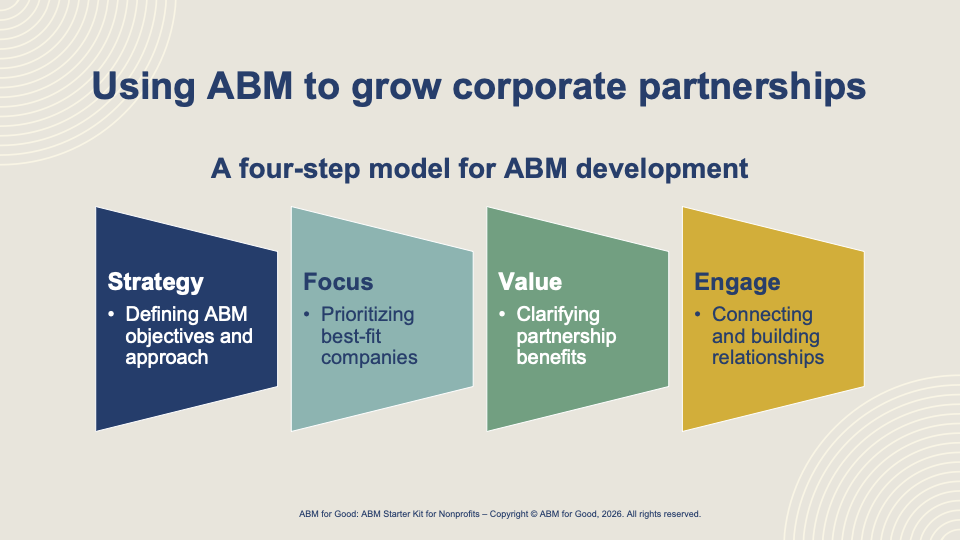
Step 1: Set a multi-dimensional strategy
First, Rob suggested that nonprofits take a broader approach to corporate partnerships. Rather than focus mainly on soliciting company checks, they should focus on the "Three I's":
Investment: Funding for your organization and programs
Influence: Collaboration and co-marketing to build awareness and interest
Impact: Hands-on support for program execution such as employee volunteers, pro bono consulting, in-kind products or services
Step 2: Build a focused, data-driven target list
Many nonprofit organizations take a broadbrush approach to a fundraising campaign and target all of the large companies in the local area. While this may be fast, it may not be efficient. With ABM, nonprofits put more energy into researching specific companies and using a scoring system to help prioritize a narrower list of high-potential targets. For example, consider researching and scoring five important attributes for each company:
Mission Alignment: Does the corporation have a history of funding your specific cause?
Business Relevance: Is there any operational crossover (e.g., an education nonprofit targeting companies selling to schools)?
Community Presence: What is the local capacity, asset scale, and employee density?
Partnership Structure: Is there an active corporate foundation or social impact framework and team?
Accessibility: Does your board or staff have connections for warm executive entry points?
Step 3: Map a dual-benefit value proposition
“Outside-in” is a core tenet of ABM communications. Instead of focusing primarily on your cause and programs, dig into how the companies perceive value with their social initiatives and sponsorships. With this understanding, nonprofits can lead with a discussion of how partnering can help address their specific challenges and objectives. For example, a nonprofit partnership can help the company enhance their brand and reputation, build new community ties, engage employees, and help align CSR values to philanthropic actions.
Step 4: Execute a multi-channel engagement campaign
Finally, Rob recommended using a highly targeted, multi-channel campaign approach that can provide multiple ways to reach, connect, and build relationships with corporate decision makers. This may include such tactics as engaging with executives on their LinkedIn feeds, personalizing direct email messages, attending relevant industry events, tailoring newsletter content to specific industry topics, and transitioning digital connections into face-to-face exploratory meetings.
High-value corporate prospecting requires deep research, narrow focus, and an integrated team approach. ABM treats corporations as strategic partners rather than simple donors, enabling nonprofits to unlock substantial, sustainable revenue.
Watch the replay of Growing Corporate Partnerships: A Practical Approach to Building Sustainable Support.
Note: AI helped the humans at ABM for Good draft and edit this article.